Hospital Bed and Mobility Equipment Support
Hospital beds and mobility equipment play an important role in patient comfort, positioning, transfers, and daily care. ACI Systems, Inc. provides equipment support for individuals, caregivers, home-care providers, rehabilitation centers, and healthcare facilities.
Our services may include equipment selection, setup guidance, troubleshooting, maintenance, repairs, parts replacement, and ongoing assistance. We work to help customers use their equipment safely and confidently.
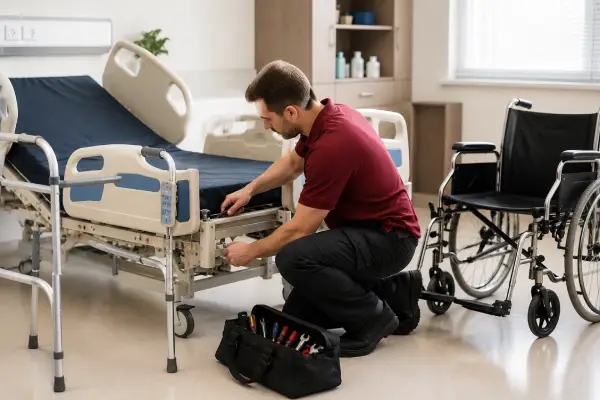
What Does Hospital Bed Support Include?
Mobility equipment support may include wheelchairs, scooters, walkers, rollators, canes, crutches, patient lifts, and bathroom safety equipment. Each product is evaluated according to its condition and intended use.
Hospital Bed Support FAQs
What types of hospital beds do you support?
We provide support for certain manual, semi-electric, and electric hospital beds, depending on the model and service required.
Can you repair a hospital bed that will not move?
Yes. We can inspect the hand control, motor, electrical system, wiring, and other components to identify the problem.
Do you repair air mattresses and pumps?
Air mattress inspection and repair may be available depending on the system, damage, and replacement-part availability.
Can you help choose a hospital bed for home use?
It requires special disposal because improper handling can create health risks, contamination, injuries, and environmental hazards.
Do you provide support for patient lifts?
We can assist with certain patient-lift equipment, accessories, inspections, and general product guidance.
Does insurance cover hospital beds?
Coverage may be available when the bed is medically necessary and supported by the required physician documentation.